The Invitation Details Guests Need Before They Reply
A clear invitation lets guests understand the occasion, decide whether they can attend, and prepare for what the day asks of them. Follow one fictional couple as they shape a useful invitation checklist.
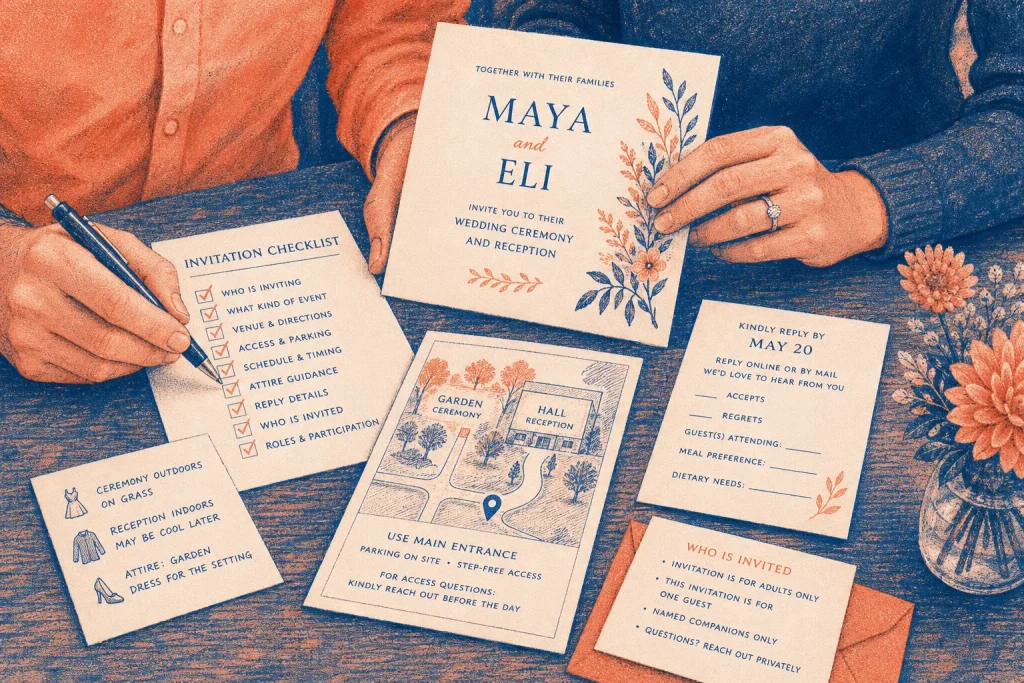
On a kitchen table, a couple sorts through draft invitations while a relative asks whether the ceremony is outdoors and a friend wonders if children are welcome. The card looks finished, but the questions keep arriving. Imagine that Maya and Eli, planning a small wedding at a garden venue, decide to treat each unanswered question as a clue about what guests still need to know. Their checklist is not a substitute for a graceful invitation. It is the practical layer that lets people reply with confidence.
Start with the occasion and the people inviting
Maya and Eli begin by making the basic facts unmistakable: who is inviting guests, whose celebration it is, and what kind of gathering they are being asked to attend. They use the couple’s names in full and make clear that the invitation is for a wedding ceremony and reception, rather than a reception alone.
This sounds simple, but names and event descriptions can be ambiguous when families are hosting together or when several events are planned. The invitation should identify the hosts in a way that feels right to the couple and their families. If the ceremony and reception have different guest lists, each invitee should receive the details for the events they are actually invited to attend.
For Maya and Eli, that means one invitation names both sets of parents as hosts, while the wording makes clear that every recipient is invited to both the ceremony and the reception. Guests do not have to infer their place from a family connection or from a note passed along by someone else.
Give guests a clear route to the venue
The venue name and street address are the starting point, not always the whole answer. Maya and Eli add a note that the ceremony will be in the garden and the reception in the adjoining hall. They explain which entrance to use, since the venue has a separate driveway for deliveries. A simple link to a map or a wedding information page can carry fuller directions without crowding the invitation.
They also consider what happens upon arrival. Is there parking on site? Is public transit a workable option? Does the venue have a step-free entrance? Guests do not need a lengthy facilities description in the main invitation, but they should be told how to ask about access needs and be given a way to do so privately.
Say Maya and Eli notice that a guest who uses a mobility aid may need to avoid the garden path. They add a contact address and ask guests to share access questions before the day. The expected result is that the guest can make arrangements with the couple or venue, rather than trying to solve the problem at the entrance.
State the schedule without creating a puzzle
The invitation should say when guests are expected to arrive and when the ceremony begins. Maya and Eli distinguish those times: the doors open before the ceremony, and the invitation gives both the arrival time and the start time. That small distinction helps guests plan travel and settle in without wondering whether “at three” means the first guest should arrive at three or the ceremony starts then.
If the day includes more than one location, the invitation or linked details should explain where guests go next and how they get there. If there is a long pause between events, say so plainly. Guests can then decide whether to remain nearby, return home, or make other plans. The couple avoids promising a precise end time when the event may naturally run longer; instead, they share a useful sense of the day’s shape and any transport arrangements that matter.
Explain what guests should expect to wear
Dress guidance is most useful when it describes the setting and the couple’s request in ordinary language. Maya and Eli write that the ceremony is outdoors on grass and ask guests to choose attire suitable for a garden. They explain that the reception is indoors and that the venue may feel cool later in the evening.
They avoid relying on a dress-code phrase that some guests may interpret differently. If a particular level of formality matters, they name it and add a short clarification. The aim is not to dictate every choice. It is to prevent guests from having to guess whether their clothes, shoes, or outer layer will suit the occasion.
Make the reply process easy to complete
A reply card or online form should make the requested response clear. Maya and Eli include a response date, a direct way to reply, and a contact method for guests who need help. They ask each invitee to respond for the people named on that invitation, rather than leaving the number of attendees open-ended.
The form asks guests to accept or decline and, where relevant, to share meal preferences or dietary needs. Maya and Eli do not ask for personal details they do not need. They also state whether guests may bring a named companion, so no one has to guess or feel awkward asking through a relative.
For example, imagine a guest receives an invitation addressed only to her and sees a response form with a field for “number attending.” She might reasonably wonder if a companion is included. Maya and Eli revise the wording to say that the invitation is for one guest, then provide a private contact route for questions. The expected result is a clear reply and fewer uncomfortable assumptions.
Say who is invited and what participation means
Families differ in how they handle children, plus-ones, and ceremony participation. The invitation should communicate the couple’s decisions without making guests decode hints. Maya and Eli address the envelope to the invited household members and include a brief note that the ceremony and reception are for adults. If children are invited, the wording can say so directly and mention any arrangements that help parents plan.
They also think about guests who have a role beyond attending. Anyone asked to give a reading, join a procession, or help with another part of the ceremony should receive clear instructions separately: what the role involves, when to arrive, and whom to contact with questions. A general invitation is not the right place to hide a task in a vague line.
Use a checklist before sending
Before approving the invitation, Maya and Eli check each item and decide whether it belongs on the card, an insert, or a wedding information page:
- Hosts and honorees: Are the names clear, and does the wording identify the occasion?
- Invitation scope: Is it clear which events each guest is invited to attend?
- Date and timing: Are the event date, arrival time, and ceremony start time easy to distinguish?
- Venue and arrival: Are the venue name, address, entrance details, and directions provided or linked?
- Access and transport: Is there a private way to ask about access needs, parking, or transit?
- Clothing and setting: Does the dress guidance reflect the location and any practical conditions?
- Reply instructions: Is there a clear response method and date, with a way to ask for help?
- Attendance details: Are children, companions, and invited household members identified plainly?
- Food and needs: Does the response process request only the meal or dietary information the hosts need?
- Special roles: Have guests with ceremony duties received separate, specific instructions?
Each item leads to a useful decision: include the information where guests will see it, link to a reliable place that holds it, or contact the people who need it individually. An invitation works like a well-labeled door. The card does not need to contain the whole house, but it should show guests where to enter and what to expect once they do.
Maya and Eli send the revised invitation after checking it with someone who was not involved in the planning. That reader spots one last ambiguity: the map link leads to the venue’s main office, not the garden entrance. They correct the link before sending. A final read from an outsider can catch exactly the sort of small assumption that feels obvious to the hosts and remains invisible to everyone else.